


Emergence of a Different Kind of Climate Opportunity in South Asia
For years, emerging markets were framed primarily through volatility and risk. In institutional investment circles, they were often associated with currency instability, fragmented infrastructure, weak regulatory systems, and unpredictable execution environments. Climate-focused investments in these regions were, therefore, frequently viewed as developmental or concessionary rather than commercially strategic.
The risks have not disappeared, of course. But the investment conversation around these markets is changing.
Investors are starting to recognize something structurally important: many of the world’s most urgent climate problems – and therefore, some of the largest future markets for climate solutions – are concentrated in emerging economies.
South Asia sits right in the middle of this shift.
The region is often discussed through the language of vulnerability: floods, heatwaves, crop stress, water scarcity, migration. What receives far less attention is the quieter transformation happening underneath those pressures. Across India, Bangladesh, Nepal, and neighbouring countries, a growing ecosystem of founders is building businesses around climate adaptation, agricultural resilience, waste recovery, decentralized energy, and circular systems.
Many of these ventures are still small. Most are local. Almost all are women-led climate enterprises operating close to communities that experience climate disruption first-hand.
That closeness to the problem changes the kind of solutions being built. Because the founders closest to climate realities are often seeing problems long before they become visible to larger markets.
Climate Innovation in South Asia Does Not Always Look Like “Climate Tech”
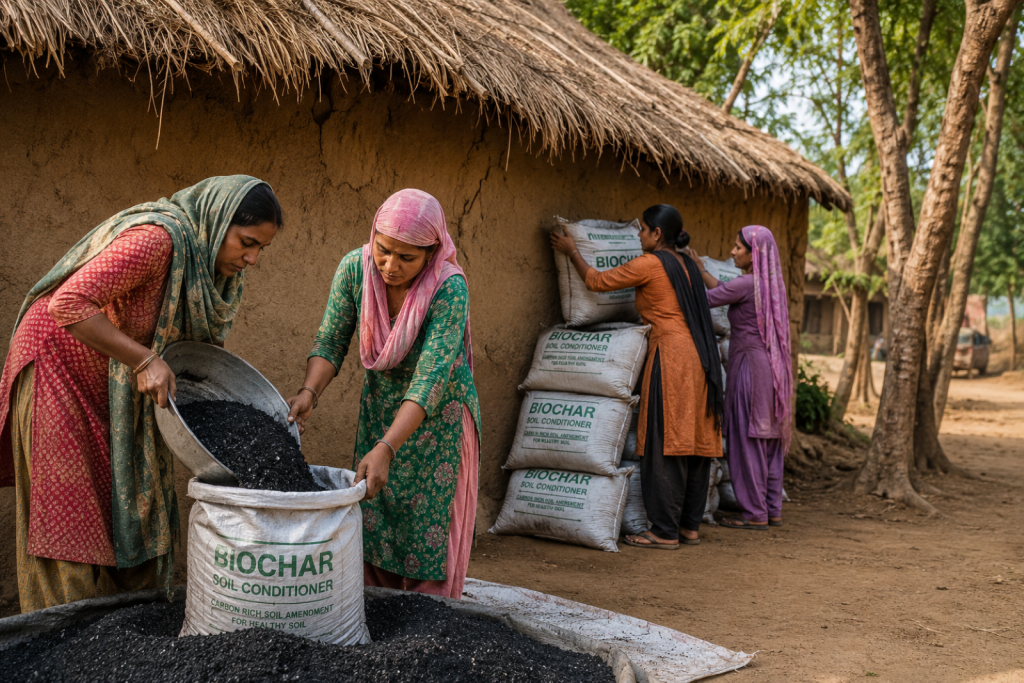
One reason the opportunity remains underestimated is that many climate innovation startups in South Asia do not initially present themselves as climate businesses. They are solving operational problems.
A founder working with farmers to convert agricultural waste into biochar may speak first about income stability or waste management before speaking about carbon markets. Another enterprise building localized cooling or irrigation systems may frame its work around productivity, livelihoods, or supply chain efficiency.
In parts of rural India, some founders are working directly with farming communities where crop residue is still routinely burned because alternative value chains barely exist. Converting that waste into biochar is not simply a climate intervention; for many communities, it is also an income intervention.
But these are increasingly climate-linked businesses.
In fact, some of the most commercially disciplined climate ventures emerging from South Asia are being shaped precisely by resource constraints. Founders are building for unreliable infrastructure, fragmented supply chains, rising heat conditions, and cost-sensitive markets. The result is often a form of innovation that is practical, adaptive, and deeply grounded in local realities.
This is where institutional investors may need to rethink traditional lenses around climate innovation.
The next wave of scalable climate solutions may not emerge exclusively from heavily capitalized technology ecosystems. It may also emerge from founders solving immediate survival and resilience challenges in undercapitalized markets.
The Gap Is Not Innovation. It Is Ecosystem Translation.
According to the World Bank, climate change could push more than 130 million people into extreme poverty by 2030 without urgent intervention. At the same time, the International Energy Agency (IEA) estimates that over 80% of future energy demand growth will come from emerging and developing economies.
The demand for climate solutions across these markets is no longer emerging, it is already visible.
Yet one of the most consistent patterns across South Asia’s climate ecosystem is that many promising enterprises struggle not because they lack viable ideas, but because they lack the ecosystem support needed to scale those ideas into investment-ready businesses.
This “missing middle” remains one of the least discussed barriers in climate finance.
Founders often require:
- market validation,
- strategic mentorship,
- customer discovery,
- compliance readiness,
- investor connectivity,
- and long-term business guidance.
Without these systems, even strong innovations struggle to commercialize.
This becomes particularly visible in sectors where markets themselves are still maturing.
Several startups working with biochar and agricultural waste, for example, are creating real climate and livelihood value while opening future opportunities through carbon credits. But India’s voluntary carbon ecosystem is still nascent, and many enterprises are building ahead of market maturity. The challenge is not always product quality. Sometimes it is timing, positioning, or identifying the right buyer ecosystem.
Many women-led climate enterprises are building in sectors where the markets themselves are still taking shape. Investors, meanwhile, often expect clear proof of demand before the ecosystem around that demand fully exists. In several cases, founders are not just building businesses – they are also helping build the market conditions required for those businesses to succeed.
This is where many climate enterprises stall. And this is also where traditional investment models often struggle to engage.
Why Institutional Capital Still Hesitates
There is also a contradiction that institutional investors are increasingly confronting.
The women-led climate enterprises closest to grassroots climate realities are often the farthest from formal capital networks.
Many investors continue to rely on conventional indicators of readiness: revenue predictability, rapid scalability, standardized reporting, or historical market data. But early-stage climate innovation in emerging markets rarely develops in such linear ways.
As a result, investors sometimes interpret ecosystem gaps as founder weakness.
Founders, meanwhile, interpret investor caution as disinterest. What investors are encountering is not simply founder risk, but ecosystem immaturity playing out in real time.
According to the Climate Policy Initiative (CPI), global climate finance flows exceeded approximately $2 trillion for the first time in 2024, yet only a fraction of that capital reaches early-stage climate enterprises in emerging markets. Much of global climate finance continues to flow toward large infrastructure projects or mature markets with clearer risk frameworks.
Meanwhile, smaller climate businesses building highly localized solutions continue to face persistent funding gaps.
For institutional investors, however, this disconnect may represent one of the more underappreciated impact investment opportunities in South Asia.
Because markets are rarely most attractive where capital is already abundant. They are often most compelling where strong demand, entrepreneurial activity, and structural inefficiencies intersect.
Role of Ecosystem Platforms in Building Investment-Ready Businesses
This is where ecosystem platforms become important – not simply as accelerators, but as translation mechanisms between climate innovation and institutional capital.
Project SAFFAL has been built around this exact gap.
At its core, SAFFAL operates as both a structured capital platform and accelerator focused on climate SMEs that are often overlooked by traditional debt, equity, and development finance channels. The objective is not simply to support startups in isolation, but to help transform promising climate enterprises into investment-ready businesses capable of absorbing and deploying capital effectively.
That process goes far beyond funding alone. It includes mentorship, market access support, investor readiness, business structuring, compliance systems, and long-term ecosystem connectivity. It also involves structuring the capital itself – whether through grants, debt, equity, or blended finance models – and managing impact monitoring across the lifecycle.
In many ways, this reflects a broader evolution happening within impact investing itself.
Institutional investors are increasingly recognizing that climate innovation ecosystems cannot be built through capital deployment alone. They require infrastructure around the entrepreneur: guidance, networks, validation pathways, and financing models aligned with how emerging-market climate businesses actually grow.
South Asia May Be Earlier Than Most Investors Realize
According to the Asian Development Bank (ADB), South Asia could lose up to 1.8% of its annual GDP by 2050 due to climate impacts if adaptation measures are not accelerated.
But climate pressure is not only creating risk. It is also accelerating entrepreneurial response. As per a factsheet released by Press Information Bureau (PIB), Government of India, on February 1, 2025, India is home to one of the most vibrant startup ecosystems with close to 30,000+ tech startups, making it the 3rd largest startup ecosystem in the world, with a growing subset focused specifically on climate solutions. What is emerging is not just an ecosystem, but a pipeline – one that is increasingly aligned with global climate priorities.
It is not simply the number of climate startups emerging from the region, but the maturity of the ecosystem around them: accelerators, catalytic capital, blended finance structures, ecosystem partnerships, and investors willing to engage earlier than before.
The early signals are already visible.
A growing number of institutional actors are beginning to view South Asia less as an aid destination and more as a future climate market. Once investors begin viewing the region as a long-term market rather than a developmental geography, capital behaviour changes with it.
Because once a region becomes viewed as a market rather than a beneficiary, the conversation changes from philanthropy to long-term capital allocation.
And that may ultimately become one of the most important shifts shaping the future of impact investing in emerging markets.
Closing Thought
For institutional investors, the opportunity in South Asia is not simply about financing climate solutions. It is about recognizing that some of the most adaptive, locally grounded, and commercially relevant climate innovation may already be emerging from ecosystems that global capital has historically overlooked.
Many of these enterprises are not operating in mature markets with established demand curves or fully developed financing infrastructure. They are building in environments where climate pressures are immediate, customer behaviour is still evolving, and ecosystem support remains fragmented. Yet it is precisely these conditions that are producing a different kind of innovation – one shaped less by trend cycles and more by lived necessity.
The question, therefore, is no longer whether climate innovation will emerge from South Asia. It already is.
The more important question is whether institutional capital can evolve quickly enough to recognize the scale of what is taking shape beneath the surface and participate before these markets become impossible to ignore.