

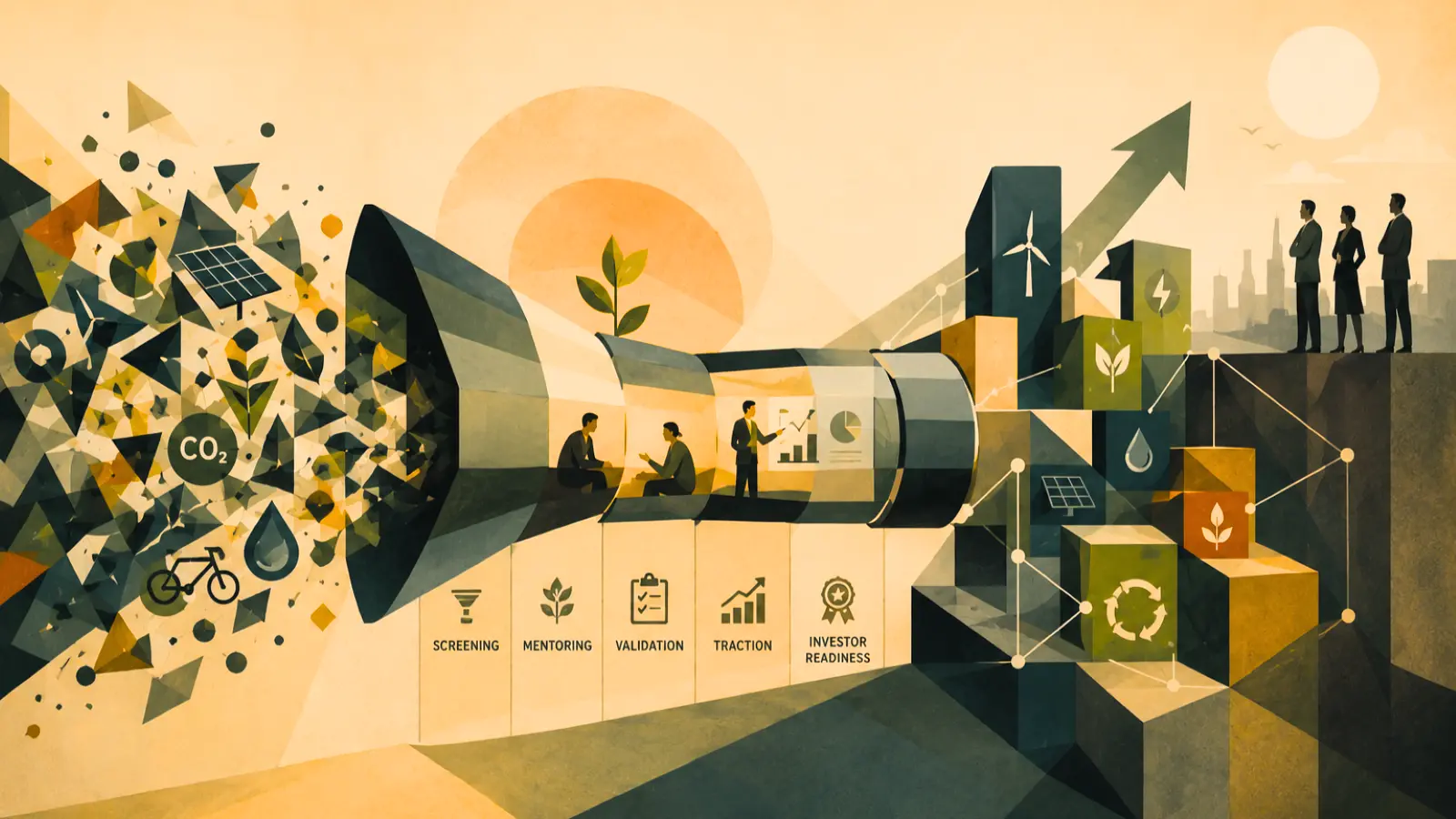
Angel networks today do not suffer from a lack of climate startups. Globally, there are now thousands of ventures working across clean energy, carbon solutions, sustainable agriculture, mobility, and climate resilience. As of 2024, there were over 2,800 active climate tech startups tracked by Pitchbook and CTVC, spanning energy, transportation, food systems, carbon removal, and more. In India, there are over 800 climate-tech startups.
The real challenge for angel networks is finding climate startups that are genuinely investment ready.
This is where a new generation of climate accelerator programs is quietly reshaping the impact startup pipeline – not by increasing volume, but by engineering readiness, relevance, and reliability into early-stage climate ventures.
The result of these programs is something far more valuable than deal flow: a curated impact startup pipeline for angel investors.
From “Access to Startups” → “Access to Prepared Deals”
In the past, accelerators were mostly founder-focused – helping startups refine their ideas, build teams, and gain traction. Climate accelerators, however, are now increasingly playing another role -preparing startups in a way that makes them easier for investors to understand, evaluate, and back with confidence.
Consider Y Combinator – has long seen as a generalist accelerator, but now a major producer of climate startups across sectors like carbon capture, energy storage, and sustainable infrastructure.
Y Combinator alone has backed more than 5,000 startups globally, with over 100 companies reaching valuations above USD 1 billion – highlighting how structured accelerator ecosystems have become major engines for building scalable, investment-ready companies.
Hence, startups like:
- Carbon Crusher (carbon-negative road construction)
- Nira Energy (grid intelligence for renewable deployment)
- Heimdal (carbon capture for transport)
… emerge from structured programs with validated use cases, early customers, and sharper investor narratives.
This shift is being driven by deliberate program design.
Accelerators are evolving into pre-investment filters, strengthening the overall impact startup pipeline by ensuring that weak business ideas are eliminated early, business models are stress-tested, and founders align with capital expectations.
For angel investors, this translates into a more investment-ready startup pipeline, where discovery is replaced by decision-making.
Rise of Thematic Climate Accelerators
Unlike generic programs, modern climate accelerator programs are deeply thematic. Platforms like SOSV (through IndieBio and HAX) and Techstars have built specialized accelerator tracks around sectors such as carbon removal, climate fintech, sustainable agriculture, and industrial decarbonization.
In India, platforms such as Villgro and Social Alpha are also playing a growing role in supporting climate and deep-tech ventures through structured acceleration support.
Climate accelerators focus on:
- Carbon Removal
- Climate Fintech
- Sustainable Agriculture
- Industrial Decarbonization
This specialization is critical.
Climate startups combine science, hardware, and policy – making early-stage evaluation difficult for generalist investors. Thematic accelerators reduce this friction by translating complexity into investable insight. They effectively upgrade fragmented deal flow into structured startup pipelines that investors can navigate with confidence.
Demo Days Are Becoming “Curated Marketplaces”
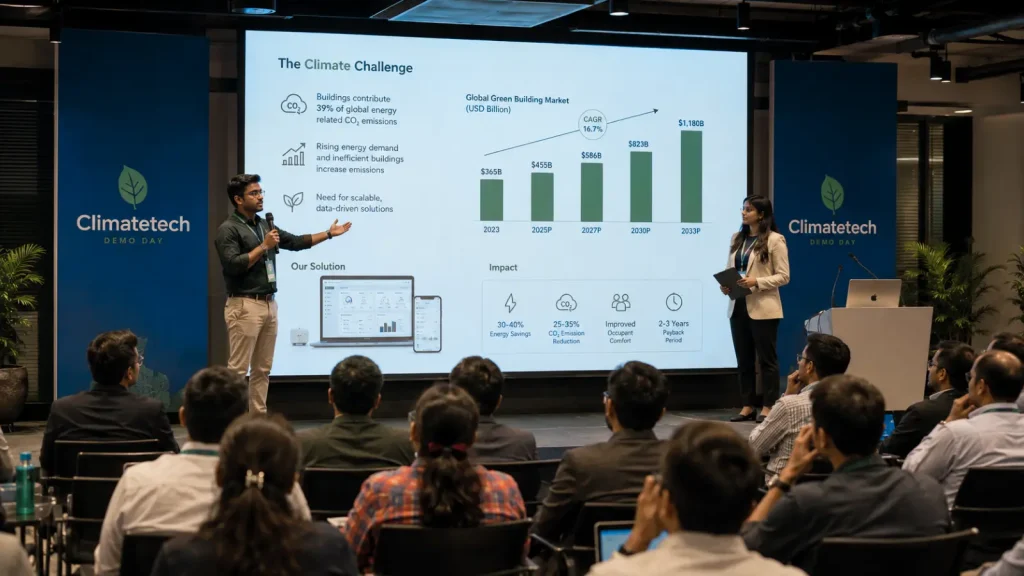
A traditional demo day is the culminating event of a startup accelerator or incubator program, where founders pitch their businesses to a curated audience of angel investors, venture capitalists, and press. These short, high-pressure presentations are designed to help startups secure follow-on funding and investor visibility.
Today, however, demo days are evolving into something much closer to curated deal marketplaces. Leading accelerators now:
- Filter thousands of applications into small, high-signal cohorts
- Benchmark startups against each other
- Present investors with a portfolio view of emerging climate sectors
For example, Y Combinator helps startups go through years of learning, testing, and business refinement within just a few months of structured acceleration. Otherwise, normally, it can take startups several years to understand their market, refine their product, find customers, and figure out what actually works.
For angel networks, this changes how they engage with the impact startup pipeline altogether.
- Faster exposure to emerging sectors: Investors gain early visibility into areas such as clean energy, climate fintech, sustainable agriculture, waste management, and carbon solutions – often before these sectors attract mainstream attention.
- Comparable deal evaluation: Because startups within accelerator cohorts go through similar mentoring and validation processes, investors can evaluate opportunities more efficiently using clearer traction signals and more structured business narratives.
- Early access ahead of institutional capital: Accelerator ecosystems often give angel investors access to startups before larger institutional investors enter the picture, allowing participation at earlier stages and more reasonable valuations.
In effect, demo days are no longer just showcases; they are becoming entry points into a curated impact startup pipeline for angel investors.
Data-Driven Screening Is Improving Pipeline Quality
Another major shift is that accelerators are increasingly becoming data-driven gatekeepers for climate investing.
Earlier, startup selection often depended heavily on networks, founder visibility, or subjective judgment. Today, many climate-focused accelerators and innovation platforms are combining AI-based screening tools with expert evaluation frameworks to identify startups with stronger long-term potential.
This is helping create more reliable startup pipelines by:
- Reducing selection bias through clearer evaluation criteria such as scalability, traction, climate relevance, and team capability
- Improving consistency in founder quality across accelerator cohorts
- Aligning startups more closely with investor expectations around governance, business models, scalability, and future fundraising potential
For angel networks, this creates a more predictable and high-quality climate startup pipeline, reducing the time spent filtering fragmented opportunities and improving confidence in early-stage deal evaluation.
Accelerators Are De-Risking “Zero-to-One” Climate Startups
One important reality that often gets overlooked is that many startups entering climate accelerators are still at a very early stage. Some may only have a prototype, an early pilot, or a strong technical concept. Many have little or no revenue, and some are raising external capital for the first time.
Under normal circumstances, these startups would be considered too risky for most investors.
This is where accelerators play a critical role. Through mentorship, pilot opportunities, investor readiness support, and ecosystem access, startups are able to validate both their technology and business models in a relatively short period of time.
In effect, accelerators compress the highest-risk phase of startup building – the “zero-to-one” stage – into a more structured and measurable journey.
This transformation converts early innovation into a more credible impact startup pipeline, where:
- Risk is partially mitigated: Investors gain clearer visibility into the founding team, market opportunity, product viability, and execution capability.
- Traction becomes visible: Startups often emerge with early indicators of momentum such as pilot projects, customer interest, partnerships, or product validation.
- Investment narratives become clearer: Accelerators help founders better articulate market opportunities, scalability pathways, and fundraising potential, making investment conversations more actionable.
For angel investors, this is the difference between speculative early-stage investing and investing within a more structured, investable pipeline.
Why This Matters Specifically for Angel Networks
Angel networks operate under constraints:
- Smaller cheque sizes
- Faster decision timelines
- Limited capacity for deep technical diligence
Accelerator-driven startup pipelines directly address these challenges. They offer:
- Pre-vetted opportunities → reducing sourcing effort
- Structured narratives → simplifying evaluation
- Cohort visibility → enabling smarter co-investment
Most importantly, they provide access to a curated impact startup pipeline for angel investors, where quality is standardized and readiness is engineered.
Strategic Shift: From Sourcing to Selecting
The shift is subtle, but powerful.
Earlier, investors competed on access. The assumption was that the investor with the strongest network or sourcing capability would see the best deals first.
Today, that dynamic is beginning to change. As accelerator ecosystems become more sophisticated, investors are no longer struggling to find startups. Instead, they are increasingly focused on identifying which startups within these curated pipelines are most likely to scale, execute effectively, and align with their investment thesis.
Accelerators have effectively transformed fragmented deal flow into high-quality, investment-ready startup pipelines. Startups are increasingly being screened, validated, mentored, and benchmarked before investors even enter the conversation.
For angel networks, this changes the nature of early-stage investing itself. Rather than spending most of their effort sourcing opportunities, investors can focus more deeply on building conviction around sectors, founders, scalability, and long-term execution capability.
The key strategic questions are now:
- Which climate accelerator programs should we align with?
- Which ecosystems consistently produce high-quality founders?
- How do we build conviction faster within these pipelines?
Increasingly, success in climate investing may depend less on who sees the most deals, and more on who makes better decisions within structured, investment-ready ecosystems.
Closing Insight: Accelerators as Infrastructure, Not Intermediaries
As climate investing matures, the challenge is no longer simply finding more startups. The bigger challenge is building stronger pipelines of startups that are actually ready for investment.
Increasingly, climate accelerator programs are becoming the infrastructure that helps transform early innovation into structured, investment-ready opportunities for investors.
This is precisely the gap that Project SAFFAL is designed to address.
Working across India, Nepal, Bangladesh, Sri Lanka, and Bhutan, Project SAFFAL focuses on strengthening the “missing middle” of climate entrepreneurship in South Asia – the stage where startups have moved beyond ideas but still require structured support to become investment-ready.
Through mentorship, accelerator support, investor engagement, ecosystem partnerships, and catalytic financing approaches, SAFFAL is helping transform early innovation into a more credible and accessible investment-ready startup pipeline.
Importantly, the initiative is also bringing greater visibility to women-led climate enterprises and locally grounded solutions that are often overlooked by mainstream capital networks despite their strong climate and community impact potential.
For angel investors, this creates something far more valuable than sporadic deal flow: a curated impact startup pipeline for angel investors built around readiness, relevance, and long-term climate opportunity.
In many ways, the future of climate investing – especially in emerging markets – will depend not only on the availability of capital, but on the strength of the ecosystems preparing startups to absorb that capital effectively.
And increasingly, that is the role accelerators like Project SAFFAL are beginning to play.