

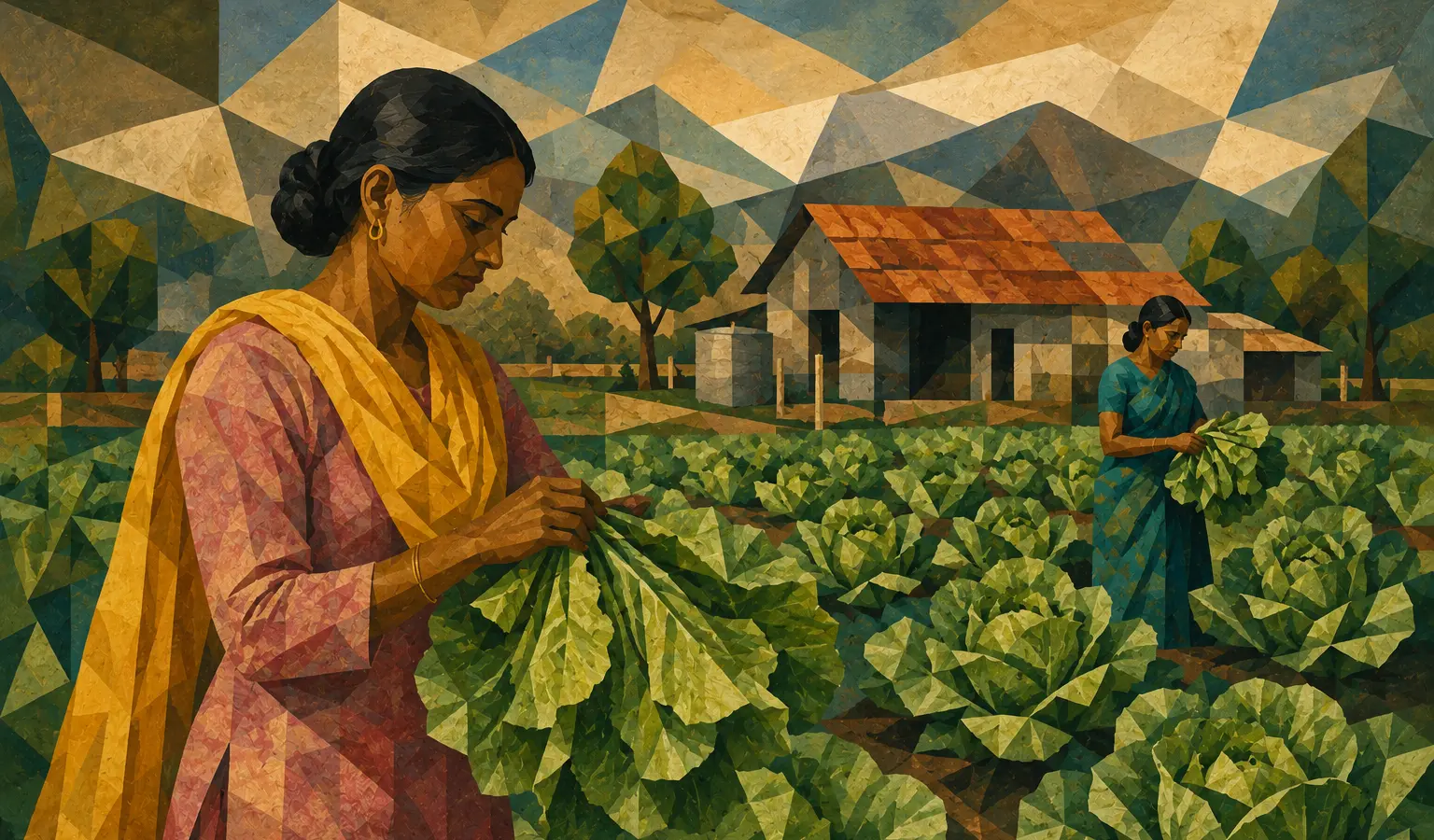
For millions of farmers across South Asia, climate change is no longer an abstract environmental issue. It is showing up through rising cultivation costs, water stress, declining soil quality, increasingly unpredictable growing conditions and unstable incomes. For many rural households, a failed crop cycle is not just an agricultural problem. It can quickly become a debt, migration, or livelihood crisis.
And as these pressures intensify, the conversation around sustainable agriculture is beginning to change shape. It is no longer being framed only as an environmental or sustainability challenge. It is increasingly becoming a farmer income story.
This shift matters because the region’s agricultural economy sits at the intersection of multiple vulnerabilities. Smallholder farming systems across the region remain highly dependent on rainfall, exposed to climate variability, and constrained by small & fragmented farms, rising input costs, and weak rural infrastructure. Recent studies have also pointed to intensifying heat stress, shifting cropping cycles, and declining ability of farming communities to cope with climate shocks.
Against this backdrop, an important pattern is emerging from the women-led enterprises participating in Project SAFFAL – a South Asia-focused initiative supporting women climate founders across sectors such as sustainable agriculture, waste management, renewable energy, and circular economy systems.
Viewed collectively, these enterprises offer a revealing lens into how climate innovation is evolving across the region.
More than 55 ventures within the SAFFAL cohort are working across sustainable agriculture and allied rural systems. Most are not building “climate products” in the abstract.
Across the cohort, this ranges from a Bangladesh-based enterprise converting agricultural waste into customized biochar to combat soil salinity, to a Nepal-based agri-platform delivering farmland-specific weather and agronomy intelligence, to mushroom farming systems in India integrating composting with local jobs and village-level income opportunities.
What connects many of these enterprises is not simply sustainability. It is the attempt to make farming systems more economically viable in an increasingly unstable climate.
That shift in emphasis is more significant than it first appears.
Sustainable agriculture in South Asia is no longer only an environmental conversation. It is increasingly becoming a farmer income story.
Climate Adaptation is Becoming a Farmer Income Story
One of the clearest observations emerging from the sustainable agriculture cohort under Project SAFFAL is that climate adaptation is no longer being positioned merely as environmental responsibility. Instead, it is now tied more directly to three practical outcomes:
- reducing farmer costs,
- improving yield stability, and
- creating additional income streams.
That is fundamentally different from how sustainable agriculture was often framed a decade ago.
Several enterprises in the cohort are working on biological soil solutions, low-chemical farming systems, natural microbial inputs, and regenerative cultivation approaches. But interestingly, these solutions are rarely presented to farmers as “saving the planet”. They are framed around healthier soil, lower dependency on expensive chemical inputs, improved crop quality, and more stable productivity.
Across the region, this economic framing is becoming increasingly important. In Bangladesh, one venture is cultivating climate-adapted crops such as quinoa and chia seeds for environmentally vulnerable farming regions, while in India another enterprise is helping tribal farmers transition toward high-value aromatic crops linked with local processing and income generation. Elsewhere in the cohort, founders are building microbial soil-input systems and energy-efficient cultivation models designed to reduce both input costs and resource stress.
In other words, sustainability strategies are now being translated into economics farmers can immediately understand. And that distinction matters because farming transitions rarely scale if they increased risk for already vulnerable households.
This is not agriculture innovation in the Silicon Valley sense of “disruption”. It is adaptation through economic pragmatism.
Farmers are not adopting sustainable practices because they sound climate-friendly. They are adopting them because they reduce risk and improve livelihoods.
Agri-Waste is Quietly Becoming Agricultural Infrastructure
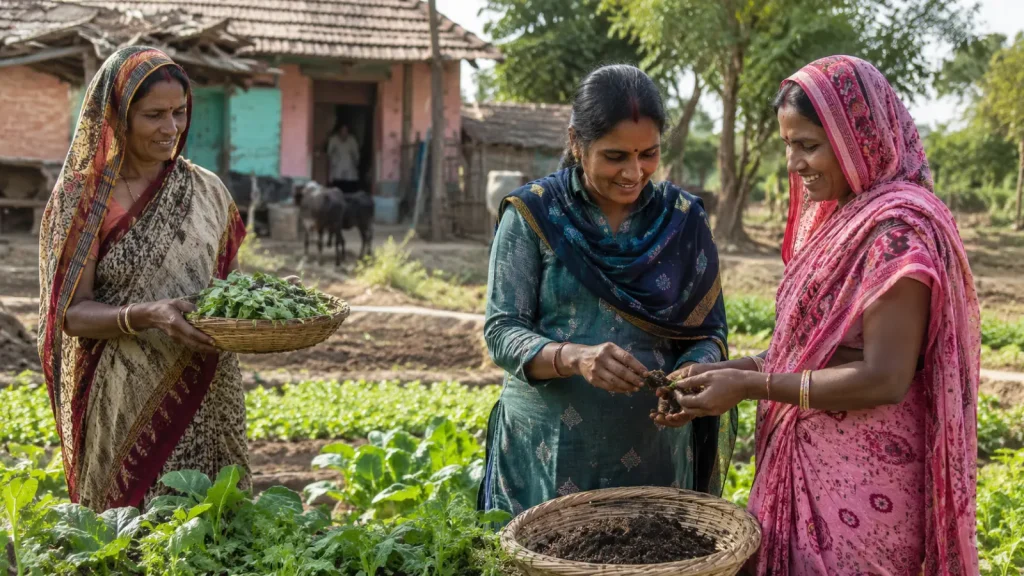
What is especially notable is how many founders are treating agricultural waste not as a disposal problem, but as productive infrastructure. This may become one of the most important structural shifts underway in regional farming systems.
Crop residue, biomass, organic waste, and agricultural byproducts are now being treated as sources of biochar, compost, green energy, animal feed, and secondary rural income. In Bangladesh, one enterprise is transforming agricultural residue into designer biochar designed specifically for saline farming conditions, while in India another platform is helping farmers monetize agri-waste through green energy and fodder systems instead of open-field burning or disposal.
In many farming regions, residue that was once burned or discarded is now beginning to generate secondary income streams.
What makes this particularly significant is that these models often solve multiple problems simultaneously. A single intervention can:
- reduce open burning and air pollution,
- improve soil quality,
- generate supplemental farmer income, and
- support decentralized rural livelihoods.
This systems-level thinking is becoming more common among climate founders in the region.
In practice, the distinction between agriculture, energy, and waste management is beginning to blur.
A platform helping farmers monetize agricultural residue for green energy generation is no longer merely an “agri startup.” A climate-resilient mushroom cultivation model linked with composting and women-led rural enterprises is no longer only about food production. These are increasingly integrated rural systems.
This hybridization matters because farming vulnerability rarely exists in isolation. Erratic rainfall, degraded soil, rising input costs, weak market access, and unstable incomes are often deeply interconnected.
The enterprises emerging from the cohort are responding accordingly. They are not building single-point technologies. They are building layered livelihood systems.
Waste is no longer only a disposal problem. It is becoming a rural economic resource.
Rise of Localized Climate Agriculture
Less discussed in climate innovation conversations is the fact that many agricultural solutions scale through localization rather than uniformity.
This is especially visible in South Asia, where agriculture varies dramatically across geography, water availability, food cultures, cropping systems, and rural economies.
Several enterprises in the cohort are deeply rooted in local agricultural realities. In Bhutan, one enterprise is building hyperlocal aeroponics farming systems suited for urban food production in Thimphu, while in Bangladesh another startup is experimenting with climate-adapted cultivation of quinoa and chia seeds in environmentally vulnerable regions. Across India, several ventures are also reviving millet ecosystems linked with tribal agricultural traditions and low-input farming models.
Unlike the dominant venture capital expectation that agricultural innovation must look highly standardized or platform-driven, many of these founders are building context-first farming systems shaped by local environmental and economic realities.
Some are working with indigenous crops that naturally require lower water intensity. Others are building decentralized local production systems around women-led rural entrepreneurship. Some are integrating livestock, composting, and cultivation into circular farm systems rather than single-crop farming approaches.
These are not accidental design choices. They reflect a growing recognition that long-term agricultural stability in the region may depend less on industrial uniformity and more on ecological diversity.
A single standardized farming model cannot effectively solve agricultural problems across highly diverse climatic and ecological conditions.
Technology is Being Used to Reduce Uncertainty, Not Replace Farmers
Technology, meanwhile, is being deployed very differently within these enterprises.
In global agri-tech narratives, technology is often positioned as automation replacing traditional farming systems. But many climate enterprises in South Asia appear to be using technology differently – as a way to reduce uncertainty inside fragile agricultural economies.
For example, post-harvest losses remain one of the largest invisible economic drains in food systems. Climate variability further worsens spoilage risks across storage and transportation chains. Some ventures are now using AI, sensor technologies, and predictive quality assessment systems to improve inventory decisions, freshness tracking, and food grading.
In Nepal, one platform is combining geospatial intelligence with farmland-specific weather advisory systems for farmers, while a couple of Indian startups in the cohort are using AI, multispectral imaging, and optical sensing technologies to reduce post-harvest losses and improve crop-quality assessment.
The value proposition is not technological sophistication for its own sake. It is helping producers, traders, and suppliers avoid preventable economic loss.
Similarly, renewable-energy-powered farming systems are often being adopted not simply because they are cleaner, but because they lower long-term operating costs and improve reliability in areas with inconsistent energy access.
Even mechanization models are now tied more directly to affordability and energy efficiency rather than large-scale industrial agriculture.
This reflects a broader shift underway in rural innovation ecosystems.
Technology alone is not the story. Risk reduction is.
Women Founders are Expanding the Definition of Climate Agriculture
Perhaps the most important insight from the cohort is that many women-led climate enterprises are operating with a wider definition of agriculture itself.
Their models frequently combine:
- livelihoods,
- nutrition,
- local employment,
- women’s participation,
- waste reduction,
- energy access, and
- ecological restoration.
In South Asia, agriculture was never only about food production. It is also about livelihoods, migration, energy access, and household survival.
Research continues to show that climate-smart agriculture must account for gender, livelihoods, and local inequalities rather than focusing narrowly on productivity metrics alone. The cohort reflects this broader understanding.
Some enterprises are creating farming ecosystems. Others are embedding local employment generation into agricultural value chains. In Nepal and India, several enterprises are combining agro-processing, decentralized farming systems, and rural women’s livelihoods, while ventures in Bangladesh are building digital agriculture ecosystems that connect farmers with financing, inputs, and market access.
Collectively, these ventures suggest that climate agriculture in the region may evolve differently from dominant global agri-tech models. Instead of pure scale-first growth, many are prioritizing affordability, decentralization, risk reduction, and livelihood stability.
That may ultimately prove far more relevant for the realities of the region.
Viewed individually, these enterprises may appear highly localized and sector specific. But taken together, they reveal something much larger: a distinct emerging model of climate-smart agriculture rooted in livelihoods, decentralization, and regional realities.
That shift may ultimately tell us as much about the future of South Asian agriculture as it does about climate entrepreneurship itself.
For many of these women-led climate startups, agriculture is not just a production system. It is a livelihood system.
What These Patterns Reveal
Taken together, the sustainable agriculture startups under Project SAFFAL reveal something larger than individual startup activity. It reveals a broader shift in how agricultural sustainability is being approached.
One where:
- sustainability is tied to farmer economics,
- waste becomes infrastructure,
- local ecosystems matter,
- technology reduces vulnerability, and
- agriculture is treated as both an environmental and livelihood system.
Many of these businesses are still small in scale. But collectively, they point toward a different model of agricultural transition emerging from the region.
Across South Asia, the future of sustainable agriculture may increasingly be shaped by smaller, decentralized, locally embedded enterprises working directly inside vulnerable communities. And many of those enterprises are being led by women. That is not simply an inclusion story, or a gender-equity story. It is an innovation story.
Because the future of farming viability in the region may not emerge from importing universal solutions into the region. It may emerge from founders building locally and directly within the realities of water stress, fragmented farming systems, local food cultures, and unstable rural incomes.
What the sustainable agriculture cohort ultimately reveals is that climate innovation in the region is becoming less about abstract sustainability narratives and more about redesigning the economics of survival itself.
And increasingly, women founders across South Asia are becoming central to that transition.